
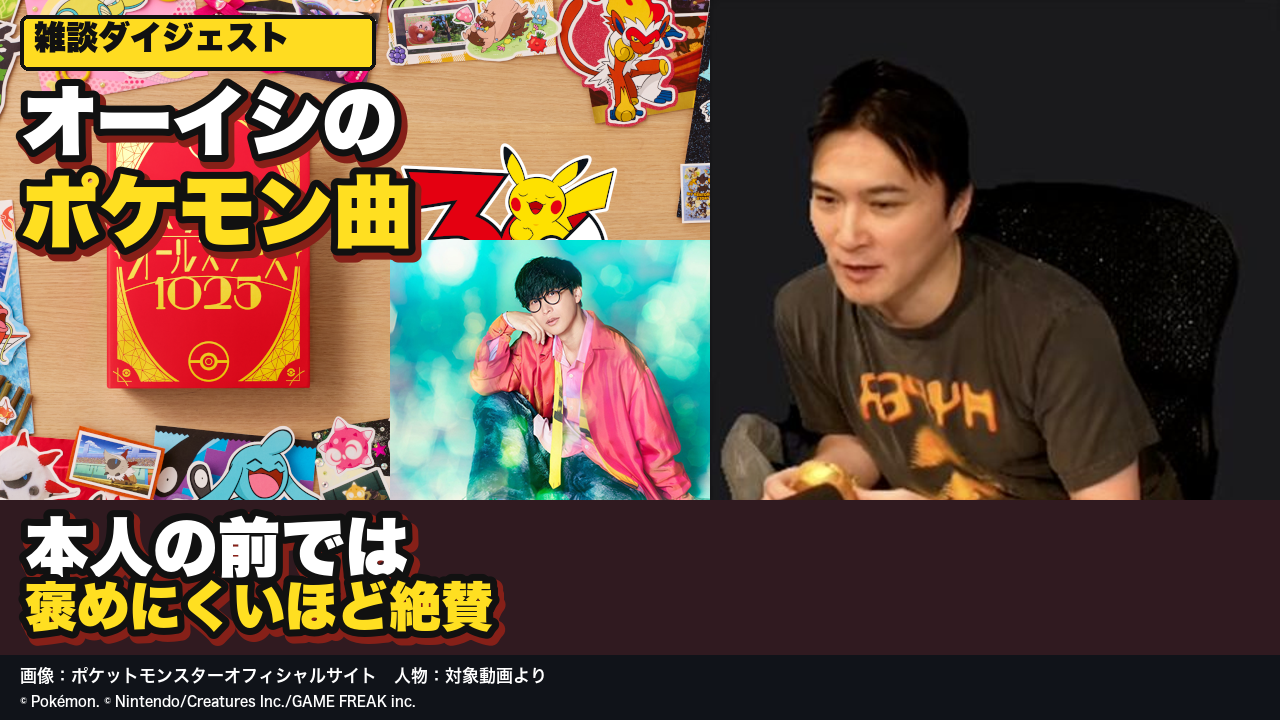
Watching repeatedly and pausing at the moments that catch his eye
As Junichi Kato begins discussing Masayoshi Oishi’s Pokémon song, he recalls watching the music video 40 times and mentions watching it at half speed. He does not say he watched all 40 times at that speed. He liked the song and video enough to examine the small details.
He singles out the part featuring Barboach. He says he could not help pausing there and urges other viewers to see it too. It is not an analysis in technical musical terms; rather, as someone who listens regularly, he looks for moments that feel distinctly Oishi.
The appeal of the scene is that he does more than report that it was a good song: he describes what he saw and what caught his attention. In the video, his urge to have someone immediately check the part he noticed comes straight through in his words.
He wants to ask if Oishi will sing it, but wonders whether that would be rude
The next topic is Oishi’s Budokan concert, which was scheduled at the time of the stream. Kato says he has plans and cannot go, but would want to rearrange them if Oishi were to sing the Pokémon song. This article does not provide the concert’s setlist or current schedule; it describes his wish at the time of the stream.
He wanted to ask Oishi whether he would sing it. But he thought that might be rude and ultimately did not ask. In the short conversation, his enthusiasm for the song sits alongside his hesitation to pose the question.
The more he praises it, the more it may look like favoritism toward a friend
Kato explains that Pokémon occupies an enormous place in his life. Oishi, someone he knows and interacts with, sings its commemorative song. In Kato’s view, this is work that deserves much more attention.
Yet he hesitates to praise Oishi to his face, wondering if it would look as though he were talking him up because they are close. When Oishi is not present, he repeatedly expresses his strong appreciation of the song.
What matters here is not how Oishi actually received that praise: his response does not appear in the video. The story concerns the embarrassment and difficulty Kato felt about sharing his own opinion.
After the praise, the conversation turns into a joke: the next time he meets Oishi, he might find himself checking whether any “Pokémon people” are nearby.
He goes on to tease himself about having calculated motives in his relationships. Sincere praise turns into a joke at his own expense.
Looking for Oishi’s signature in both the visuals and melody
Toward the end, the conversation returns to specific parts of the music video. He reacts to its page-turning imagery and notes footage from Pokémon Snap, cards, and the anime. He recalls finding three or four places that felt like Oishi, even though the musical style was different. He looked so closely for the signature of a creator he knew that he says he could not make notes of everything.
The Barboach moment he mentioned at the start comes up again. Rather than watching once and moving on, he pauses at what catches his attention, listens again, and searches for the signature of a creator he knows. His way of watching at the beginning connects with the concrete example at the end.
Beyond Jun’s perspective: embarrassment and specific things he loves
This is an editorial perspective. The appeal lies in how many specific things he likes emerge as he says he finds it hard to praise Oishi. If the story were only about their closeness, it might end with an explanation of his restraint. Instead, the video returns to playback speed, the spot he paused, the construction of the music video, and familiar melodies, conveying how much he watched and enjoyed it.
While presenting what he felt was “Oishi-like,” we should also understand the work as the product of multiple creators. That context lets us read his praise as a response to the creators’ work, not only to the appearance of someone he knows.
Sources and editorial approach
Original stream (according to the published video description) ↗
Based on the Japanese captions and description of a published clip. Kato’s impressions and wishes at the time of the stream are distinguished from the official description of the song. This article has not independently checked the original audio or the concert’s actual setlist.