
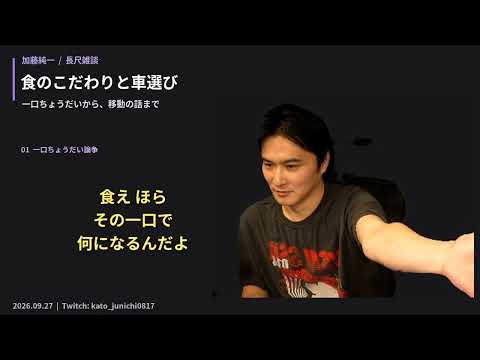
Sharing a bite or eating together
The chat begins with his reaction when asked to share just one bite. That small division apparently does not sit right with him. The conversation moves to an extreme: he would rather give away the whole thing and eat something else. Instead of cutting a perfectly sized bite, his impulse is simply that if someone wants it, they can eat it.
Listening further, he does not always dislike sharing itself. A dish ordered from the start for everyone to share, or food already divided into portions, is different. To him, dividing an individual meal afterward and choosing a dish to share from the outset have different meanings. Whether it was decided at the time of ordering becomes an important dividing line in the conversation.
But then he says he too cannot help eating other people’s food. He insists that he would not eat it if it were not in front of him, but if it is there he does. He also says he has never had something he bought eaten by someone else because he eats it the moment he leaves the convenience store. The person who struggled with sharing a bite now offers the reasoning of someone who wants to eat. The exchange is funny partly because of that self-serving logic.
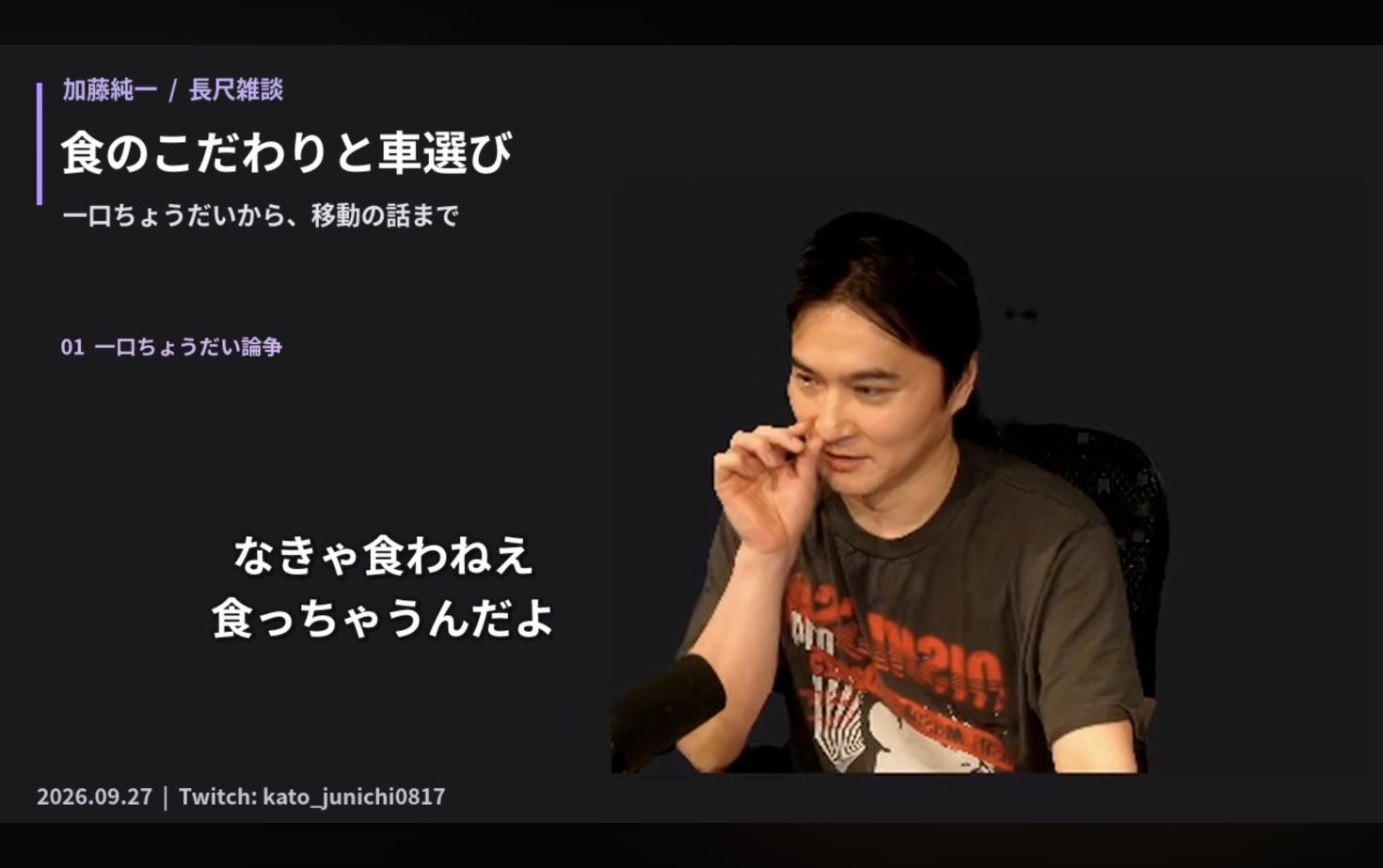
His logic gets even more self-serving over sweets in the fridge
Another published clip from the same day’s stream includes a discussion of sweets in the fridge. Starting with his tendency to eat sweets in front of him regardless of who bought them, an exchange with comments begins. His reasoning about sharing expands into the reasoning of the person eating what was left.
When someone suggests buying more, he says that if there were three times as much, he would eat three times as much.
Then buy four times as much: the calculation never ends. While seeming to solve the problem, the conditions keep increasing in favor of the eater.
To the suggestion of writing a name on the food, he responds by suggesting writing his own name on the refrigerator itself. A discussion of how to leave someone else’s portion becomes a rationale for claiming the entire fridge. It is better heard as a conversation in which he keeps answering comments in kind than as a serious household proposal.
Toward the end, however, he says he does not touch his nephew’s portion. An exception for someone close to him joins the claim that he eats everything.
Amid his insistence that he eats everything, he realizes he may choose whose food he eats. The exception is his nephew’s portion, which he does not touch.
Watching eating videos can be satisfying in itself
The topic moves to his own enjoyment of eating and then to the videos of people eating that he often watches. Watching is not only about wanting the same food. For him, the time spent watching someone enjoy a meal is itself pleasant and satisfying.
He also distinguishes his preference for watching the eating from watching the cooking process. He says he spent a long time watching eating videos the day before as well.
He says the portions are too large for him to finish, yet recalls choosing to watch such videos. His preferences as an eater and his enjoyment as a viewer appear as separate things.
Although he is reluctant to take a bite of another person’s meal, he can keep watching footage of people eating happily. Even a large portion he could not finish himself can be enjoyed on video. This shows a different pleasure in food as a viewer from the sharing discussed at the start.
The pleasure of eating also appears in his impressions of a dish
The talk about eating videos leads into concrete experiences of dining out and ordinary orders. Rather than discussing the amount spent on food, it conveys that meals are a daily pleasure for him.
Toward the end, he also comments on a dish he ate recently. He recalls that it tasted good, while saying that personally he would have been even happier if it had contained meat. The passage is about what food he likes, not a rating of a restaurant or menu.
His explanations of food preferences do not end with abstract reasoning. One familiar experience follows another: the pleasure of watching videos, what he usually eats and impressions of flavor. From the small question of sharing one bite, the conversation extends to his enthusiasm for food in daily life.
What he wants from a car: ease of travel over appearances
When the topic changes from food to cars, he says he is interested in a small car rather than a large one. He recalls that a previous car looked cool but was too large to find parking, and thinks a manageable size would be good next time. Rather than describing appearance in detail, he imagines how he would actually use it.
One candidate is a compact Lexus. The LBX also comes up; without knowing the terminology well, he thinks this size might suit his use. He wants ease of travel over looks or status. Although he says he does not know much about cars, he is clear about what he wants.
What he describes is wanting a car at the time of the stream and his impressions of candidates. It is not a report that he actually bought one. It is best read as him using past experience to consider priorities for a future choice.
Thinking about car criteria through inconvenience away from home
In the last topic, his expectations of a car become more concrete. He wants ease of driving rather than looking cool. He recalls the burden of looking for a taxi away from home, failing to find one and waiting for a while. Rather than car enthusiasm, he approaches it practically: how to reduce travel inconvenience.
This helps explain why he considers a small car. Rather than longing for a large car, he wants something easy to drive so he can travel himself when needed. His criterion is not status or others’ opinions but how manageable he can make daily travel.
Another video also discusses photos during meals
In a separate published video, Junichi Kato uses strong language to complain about repeatedly taking photos during meals. This is his opinion, not a rule for dining.
It is unverified whether this short video and the food discussion above come from the same stream or event. His manner and surrounding context can be checked in the video.
Beyond Jun highlight: choosing what he likes by his own standards
The interest of this article is that his own criteria remain visible as the subject changes from sharing food to choosing a car. With meals, he distinguishes food ordered for everyone to share from dividing an individual order afterward. With eating videos, he discusses enjoyment as a viewer rather than as the eater. With cars, he considers everyday ease of travel over outward appearance.
None is a universal conclusion; they are his preferences and views at the time of the stream. Following the chat from one bite to eating videos, food preferences and car usability shows concretely what he finds enjoyable or convenient.
Video chapters
- 0:00 Sharing a bite
- 12:57 Impressions of a dish
- 13:55 Considering a small car
- 20:26 The inconvenience of finding a taxi away from home
Sources and editorial policy
Original stream (according to the published video’s description) ↗
This summarizes a published chat digest and a clip about sweets using the same day’s stream. The original audio and individual speakers were not independently verified for this article. The separate published video is described as a separate scene. These are topics and preferences at the time, not confirmation of a car purchase. LBX specifications are supplemental information from the manufacturer.