
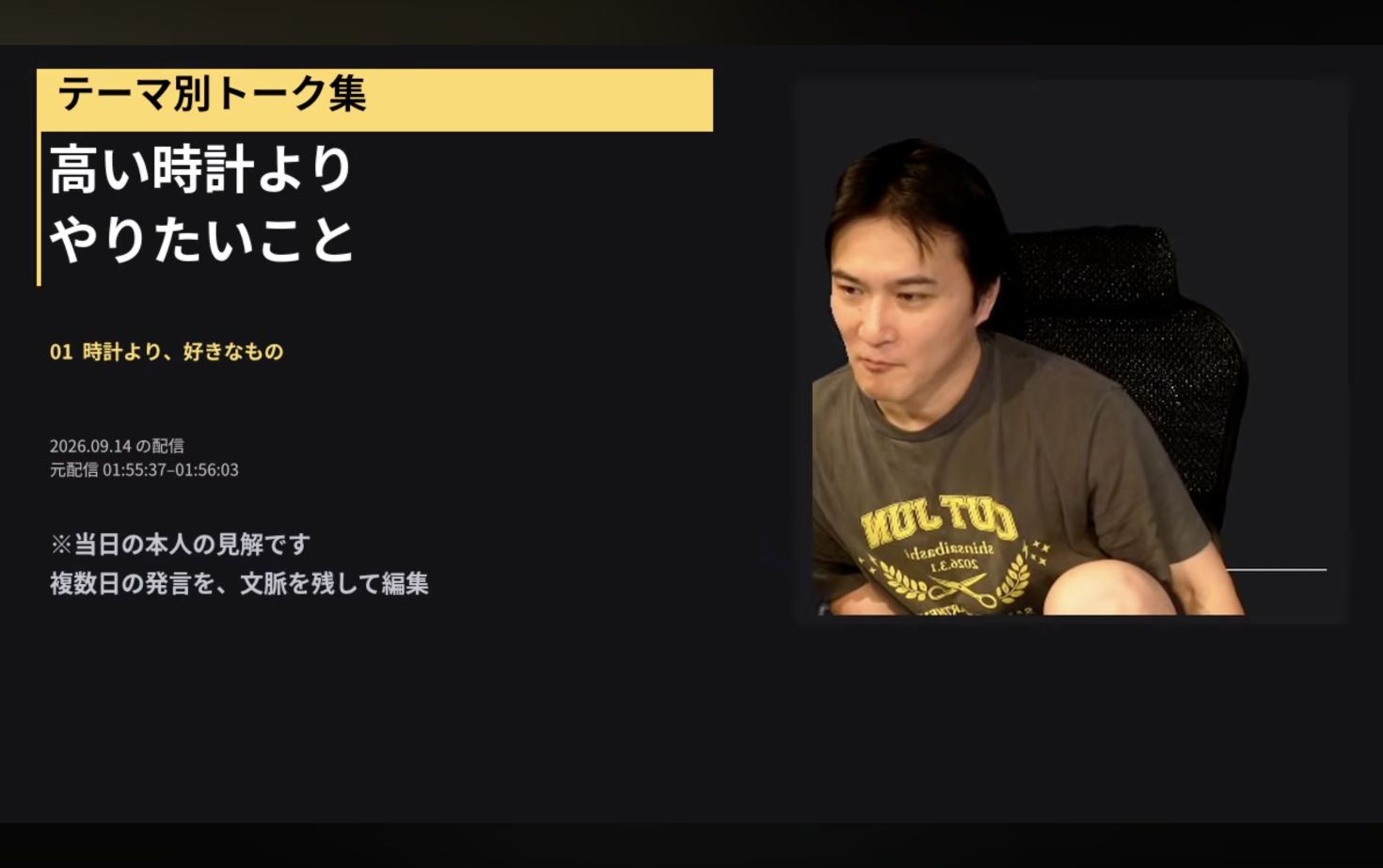
When it is too expensive, wearing it outside is frightening
A September 14, 2026 stream. Kato, who says he is not very interested in watches, imagines going out wearing an expensive one. If he bumped it, would he think about nothing else? He understands that it looks cool and costs a lot, but says he could not enjoy something he could not use without worrying.
In the video he says he has owned a watch and gives specific amounts for what he can understand spending. This is not a description of everyone who owns expensive things; it reveals a very personal measure of how he would feel.
He understands spending on a house or car, but says describing a watch as an investment does not sit right with him. Rather than discussing whether its price will rise, he finds it easier to understand buying it because one wants it and wearing it because one likes it. From here the topic shifts from the price of watches to what he likes.
He wants to display paintings he likes, even without expertise
When a viewer raises the price of paintings, he says he would rather buy a painting than a watch. He says he has no specialist knowledge of art, yet likes paintings and displays them at home. He adds a memory of liking them since childhood and his father displaying paintings at home.
“If I were buying a watch, I’d rather buy a painting.”
“I like paintings. Since I was little.”
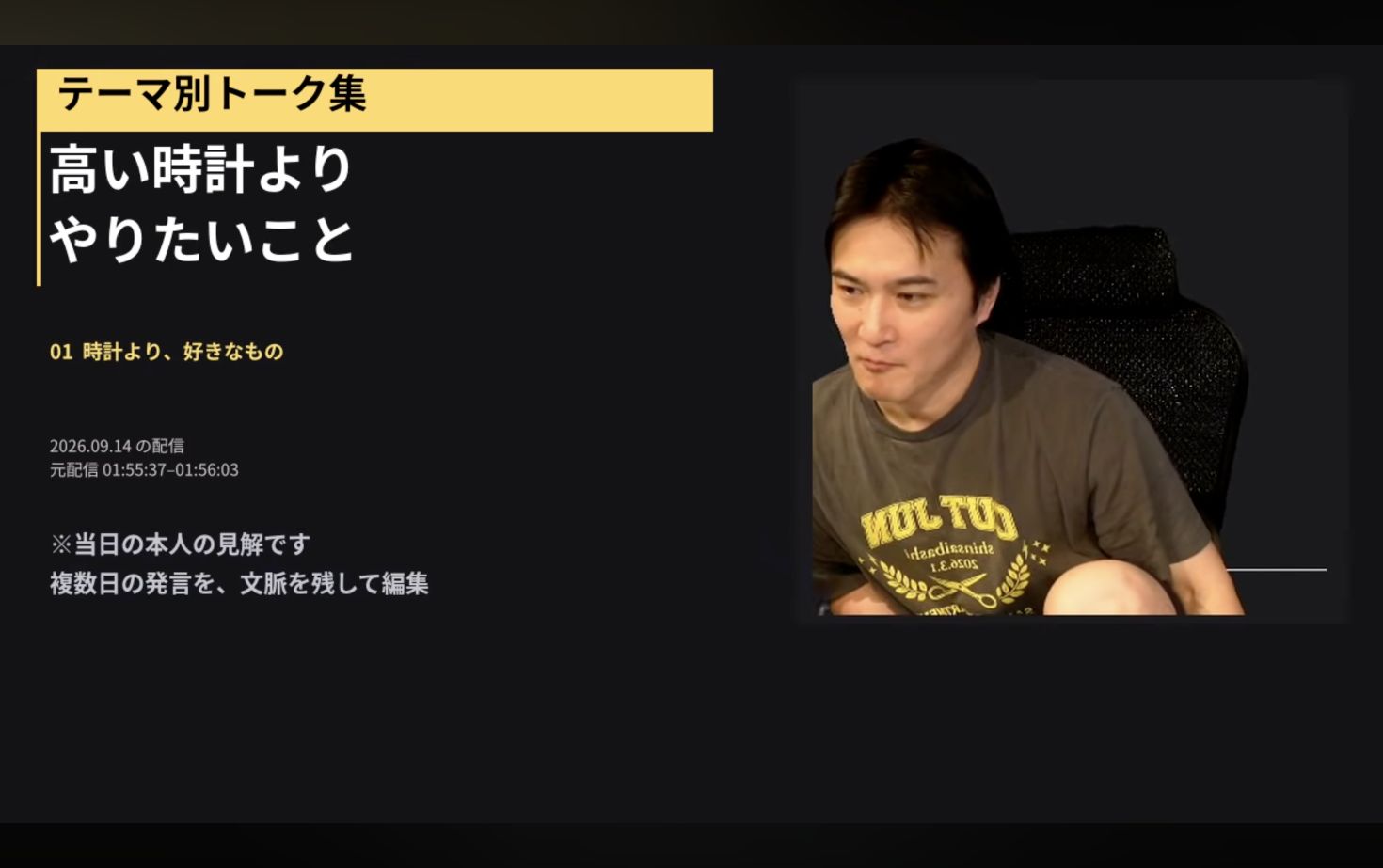
What is interesting is that lack of expertise and liking art sit side by side. Rather than explaining artists or techniques before asserting a preference, he talks about wanting to keep a painting at home and look at it. A way of enjoying something that was hard to imagine with watches becomes a concrete pleasure in his life with paintings.
The video gives no basis to identify which works by which artists he owns or their purchase prices. But a discussion of what to buy becomes mixed with his tastes and memories of his childhood home. Alongside the watch discussion, it shows how his response to the same price can change depending on whether he can enjoy the item.
Using earnings to start what he wants to do next
The video now switches to a separate September 3 stream about the gaming team and soccer team he runs. Running them while paying people salaries costs money. He explains this and recalls that he did not start the businesses with increasing money as the first goal.
He earns through streaming, then finds something he wants to do and starts it. The video presents that sequence energetically. He goes on to say that even if he could stop the business and buy something else, he would not want to. His remark that one should do what one likes comes in this context.
“I earn with just myself, then go, ‘Whoa, I want to do this!’ and do it.”
This is not household-budget advice that everyone should follow, nor an investigation into the teams’ current finances. It is his account of wanting to put streaming income into activities he finds interesting. The conversation beginning with watches expands into the difference between owning something and trying something.
Balances and team remarks, in the tone of casual conversation
At 3:31, the video moves to a September 20 stream and his comment that he rarely checks his bank account.
“I don’t look at my account.”
“Even if it goes down, I don’t notice.”
He then considers whether listeners would respond “So what?” if he talked about saving a lot. Would simply talking about an increasing balance be uninteresting to viewers? Using hypothetical large sums, he describes his lack of interest in showing how much he has saved. The amounts mentioned cannot be read as his actual deposits.
The topic then turns to money for building a hospital, leading to a joking declaration that he will enter saving mode next year. He exaggerates as if playing a game’s “eco rounds” for three years. Coming immediately after his claim that boasting about savings is meaningless, this should be understood as a joke in that conversation. Actual hospital construction and future savings plans have not been verified.
Near the end, he also discusses team management and revenue. Mentioning sponsors, merchandise and fan clubs, he explains that Kings roughly breaks even, then shifts to the separate issue of needing to consider monetizing Murash FC. He ends by taking responsibility himself, saying his failure to address it is his own negligence, not the team’s. This is his statement on stream, not verified financial information. Placing separate days’ conversations side by side connects spending on activities he chose with taking responsibility for running them.
Beyond Jun’s focus: enjoyment over price
From why he does not buy a watch to paintings and running teams, the conversation expands into what he wants to spend money on. He worries about scratching a watch. He likes paintings without being an expert. He continues teams because he wants to, even if they cost money. Together these show more than a simple dislike of expensive things.
A discussion of a purchase becomes one about activities he started himself. Even in a short conversation, following that transition is rewarding. If a passage interests you, the links at each heading let you hear the tone in which he speaks.
Video chapters
- 0:00 September 14: watches and his preferences
- 2:34 September 3: spending on what he wants to do
- 3:31 September 20: why he does not check his account, and additional notes
Sources and editorial approach
Original stream 1 (per the published video description) ↗
Original stream 2 (per the published video description) ↗
Original stream 3 (per the published video description) ↗
The published clip’s Japanese captions and description were consulted. The video combines streams from different days. Original audio and speakers have not been independently checked. Impersonated lines are not presented as the other person’s actual speech; assets, business finances and future plans are not asserted as independently verified facts.